
Search Graham County Court Records
Graham County court records are searched first through the North Carolina eCourts Portal and then through the Graham County Clerk of Superior Court when a full file, older paper record, certified copy, or counter terminal search is needed. The Graham County Judicial Branch page points users to court dates, calendars, local rules, payments, and courthouse contacts. Portal Smart Search is the broad online entry point for case information, while Search Hearings is used for hearing dates and dockets.
The Portal may require JavaScript, cookies, and a CAPTCHA. A name search works best when the user has the spelling used in the court file. A case number is better when known. A county filter should be set to Graham County unless the person may have cases in other North Carolina counties. For criminal background checks, paper files, or certified copies, the Judicial Branch directs users to the clerk's office rather than treating Portal as a complete background database.
- Open the NC eCourts Portal and choose Smart Search for case records.
- Enter a record number or a party name in last, first middle format.
- Use Advanced Filtering Options and select Graham County as the location.
- Use Search Hearings when the goal is a court date, hearing type, courtroom, attorney, or judicial officer.
- Contact the Graham County Clerk of Superior Court for full files, copies, payment routing, or older records.
The official county landing page shows the local court links used for the Graham County court records workflow.
The Judicial Branch county page is shown in the image below.
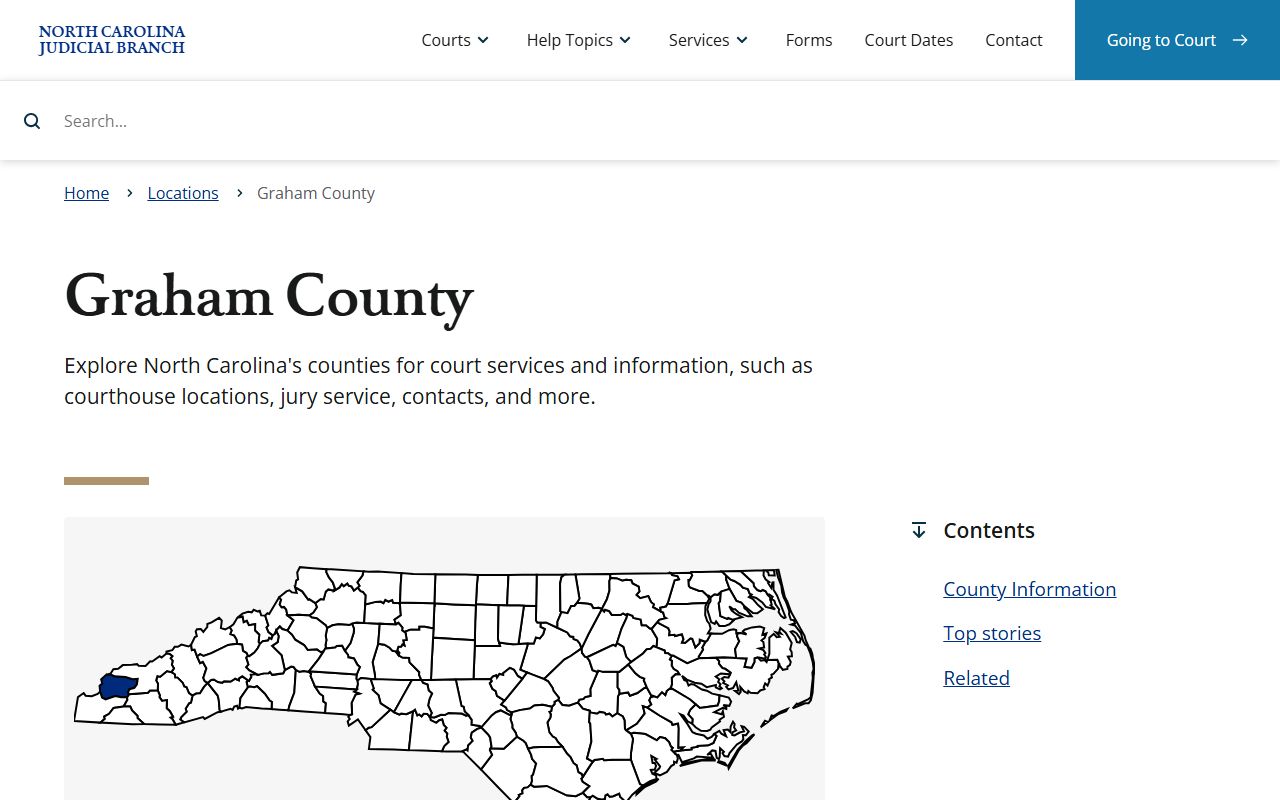
That page is the best starting point when a user needs both local Graham County links and statewide court services in one place.
Graham County Court Offices
The main court location is the Graham County Courthouse in Robbinsville. The North Carolina Judicial Branch lists the courthouse at 12 Court St., Robbinsville, NC 28771, with public hours Monday through Friday, 8:00 AM to 5:00 PM. The clerk's county page uses 12 North Main St. for the Clerk of Superior Court. Both descriptions point to the courthouse block in the center of Robbinsville.
Graham County court users may need more than one office. The Clerk of Superior Court handles filings, court records, copies, estates, special proceedings, and divorce judgments. The Register of Deeds handles marriage licenses and recorded land records. The Sheriff's Office and jail handle custody and law enforcement records. The magistrate office handles small claims, warrants, bail, and some minor criminal or infraction matters.
Graham County Courthouse
12 Court St.
Robbinsville, NC 28771
(828) 479-7000
Monday-Friday, 8:00 AM-5:00 PM
Clerk of Superior Court
12 North Main St.
Robbinsville, NC 28771
(828) 479-7000
Mail: PO Box 1179
Graham County Jail
11 Court St.
Robbinsville, NC 28771
(828) 479-8650
Jail Captain Scharlene Wesley
The official courthouse page identifies the address, hours, phone, and courthouse details used for in-person access.
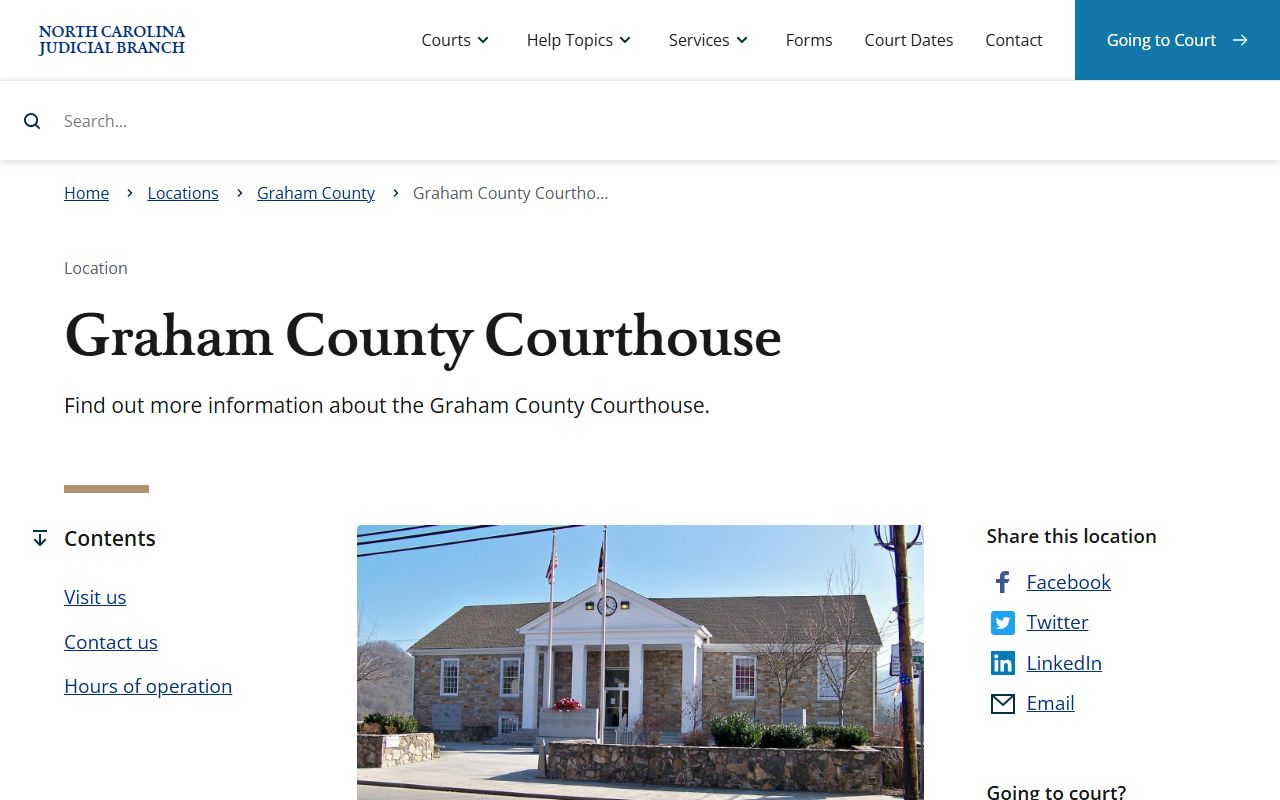
The courthouse page supports the local address and public hour details that matter before a clerk counter visit.
Graham County Court Structure
North Carolina uses a unified court system. Graham County is in Superior Court District 43A, District Court District 43, and Prosecutorial District 43. The primary trial court name for this site is Superior Court, but many day-to-day Graham County cases begin or stay in District Court. Magistrates work within the District Court structure and are important for small claims, arrest warrants, bail, and certain minor waivers.
Superior Court handles felony criminal cases, civil cases over $25,000, and misdemeanor or infraction appeals from District Court for a new trial. District Court handles civil cases under the Superior Court threshold, traffic infractions, misdemeanors, juvenile matters, domestic cases, and magistrate matters. Appeals from the trial courts can move to the North Carolina Court of Appeals, and the Supreme Court of North Carolina is the state's highest court.
| Court or Office | Graham County Role | Common Records |
|---|---|---|
| Superior Court | Felonies and larger civil cases | Felony files, civil judgments, appeals from District Court |
| District Court | Lower trial court | Misdemeanors, infractions, traffic, domestic, juvenile, civil under $25,000 |
| Magistrates | District Court judicial officers | Small claims, warrants, bail, minor waivers |
| Clerk of Superior Court | Local record keeper | Case files, indexes, estates, copies, judgments |
Typical case flow: citation or warrant > magistrate or District Court intake > District Court hearing > Superior Court for felony prosecution or appeal > appellate review when allowed.
Graham County Court Record Types
Graham County court records include more than one kind of file. Criminal files may show warrants, citations, charging documents, bond conditions, hearings, pleas, judgments, dismissals, probation, and sentencing. Civil files may show complaints, motions, orders, judgments, liens, foreclosures, partitions, or condemnations. Domestic files may involve divorce, custody, child support, alimony, equitable distribution, or protective orders.
Estate and special proceeding files are handled through the Clerk of Superior Court. Traffic records are usually District Court matters and may include citations, court dates, waivers, failures to appear, fines, costs, and appeals. Juvenile, adoption, mental health, sealed, expunged, and protected personal information are not open in the same way as ordinary adult public files.
- Court records: case files, dockets, orders, judgments, and clerk indexes.
- Criminal records: filed charges, hearings, pleas, disposition, and sentence details.
- Traffic records: citations, waivers, payments, court dates, and failure-to-appear consequences.
- Marriage and divorce records: marriage licenses through the Register of Deeds and divorce judgments through the clerk.
- Estates records: wills, inventories, accountings, guardianships, and special proceedings through the clerk.
The Graham County contact directory shows the clerk, judges, district attorney, magistrates, mediation, and court program numbers.
The directory helps match a record question to the correct office before a user makes a request.
Graham County Court Search Fields
Portal Smart Search gives Graham County users several ways to narrow a case lookup. The broad search box accepts a record number or a name. Advanced filters can narrow by location, party details, date of birth range, case type, case status, and file date range. Search Hearings is separate and uses location, hearing type, search type, and party or attorney fields for court-date work.
| Field | How It Helps |
|---|---|
| Record number or name | Searches a known case number or party name in last, first format. |
| Location | Selects Graham County instead of all North Carolina counties. |
| Case type and status | Narrows civil, criminal, domestic, estate, or other file groups when available. |
| File date range | Limits results to a filing period. |
| Hearing type | Filters Search Hearings by civil, criminal, family, probate, or mental health settings. |
Portal results should be read as case information, not a guarantee that every document is downloadable. Full court files and copies may still require the Graham County clerk's office.
Graham County Court Access Laws
North Carolina public access rules come from several sources. N.C.G.S. 132-1 defines public records broadly for government agencies. Court records also have a specific clerk statute: N.C.G.S. 7A-109 requires clerks to keep records, files, dockets, and indexes and says those clerk records are generally open during regular office hours unless a law says otherwise.
That public access rule has limits. Law enforcement criminal investigation and criminal intelligence records are not public records under N.C.G.S. 132-1.4. Juvenile court records are restricted under N.C.G.S. 7B-3000. Expunction statutes can remove qualifying arrests, charges, or convictions from public view. For Graham County court records, the practical route is Portal for case information and the clerk's office for public terminals, files, and copies.
Key point: Court case records, sheriff investigative records, and county-manager records use different custodians and request paths.
Restricted Graham County Court Records
Restricted records should not be expected in a normal Graham County court records search. Juvenile delinquency, abuse, neglect, dependency, adoption, involuntary commitment, sealed records, expunged records, protected addresses, Social Security numbers, and financial account data can be withheld or redacted. A public Portal result also may not show every document that exists in the file.
Expunction is a North Carolina process that clears qualifying public record entries after a court order. Eligibility depends on the statute and the outcome. A Graham County petition tied to a local case is filed through the Clerk of Superior Court. Once granted, agencies process the order so public record entries are removed or restricted. Sealed and expunged cases should not be used to judge the completeness of a public online search.
Graham County Criminal Records
Criminal court records and court charge records are related, but they are not the same file. A charge record focuses on the offense filed after an arrest, citation, warrant, information, or indictment. The full criminal court record adds hearings, motions, pleas, verdicts, dismissals, judgments, sentencing, probation, and payment entries. Graham County misdemeanor and infraction matters are generally District Court records; felony prosecutions proceed in Superior Court.
The District Attorney for Prosecutorial District 43 handles prosecution decisions for Graham County and nearby counties. The Public Defender for Defender District 43 serves eligible appointed cases. Law enforcement records, jail booking information, prosecutor decisions, and clerk case files each answer a different question. A court file is the best place to confirm the status of a filed charge, while the jail can answer current custody questions.
Graham County Warrant and Inmate Records
No official online Graham County active warrant list was located in the research, and the Sheriff's Office page does not publish a county jail roster. Warrant questions usually start with the Magistrate's Office at (828) 479-7019, the Sheriff's Office at (828) 479-3352, the jail at (828) 479-8650 if the person may already be in custody, or the clerk at (828) 479-7000 for court dates and case status.
The jail is listed at 11 Court St. in Robbinsville, with Jail Captain Scharlene Wesley as the jail contact. The Sheriff is Russell Moody. For sentenced state offenders, the NC Department of Adult Correction offender search is separate from the county jail. The NCSBI sex offender registry is also separate. Federal inmates are searched through the Bureau of Prisons, not through Graham County.
The official Graham County Sheriff page gives the sheriff and jail contact details that support custody and warrant routing.
Because no live county roster or warrant database was verified, those phone channels matter more than a web search.
Graham County Traffic Court Records
Traffic cases are District Court matters in Graham County. Some citations can be waived and paid online, in person, or by mail. Paying instead of contesting means the person gives up the right to appear and is treated as guilty or responsible as charged. That can affect driver-license and insurance consequences, so a court traffic record is different from a North Carolina DMV driving record.
The Graham County payment page says mail payments must be money order or certified check, payable to Graham County Clerk of Superior Court, mailed to PO Box 1179 in Robbinsville. Cash and personal checks are not accepted by mail. In person, cash, credit or debit card with processing fees, money order, or certified check may be used, but personal checks are not accepted. Online payments use eligible North Carolina court services and card processing rules.
| Payment Channel | Graham County Rule |
|---|---|
| Online | Available only for eligible criminal, infraction, probation, or parole matters. |
| Money order or certified check only; include citation number when applicable. | |
| In person | Cash, card with processing fees, money order, or certified check. |
The Graham County payment information page provides the local payment rules for eligible court costs and citations.
Payment and transit details both matter for rural court users who must choose between online handling and a courthouse trip.
Graham County Marriage and Estates Records
Marriage licenses in Graham County are handled by the Register of Deeds, not the Clerk of Superior Court. Register Kim D. LeQuire's office is at 12 North Main Street in Robbinsville and lists office hours of Monday through Friday, 8:00 AM to 4:30 PM, with a lunch closure from 12:00 PM to 1:00 PM. The Graham County marriage license fee in the research is $60.
Divorce judgments are court records from the Clerk of Superior Court in the county where the divorce was granted. Estate and probate records are also handled through the clerk because North Carolina does not use a separate named probate court for Graham County. Estate files may include wills, letters, inventories, accountings, creditor claims, guardianship records, and special proceedings.
- Executor
- A person named to administer an estate under a will.
- Intestate
- A case where a person dies without a valid will.
- Special proceeding
- A clerk or court matter such as estates, foreclosures, partitions, and guardianship.
Graham County Court Calendars
Court dates can be searched through Portal Search Hearings, but Graham County also has local administrative schedules, civil calendars, criminal calendars, and local rules links through the Judicial Branch. These matter when a user needs a published calendar, a rule for docketing, arbitration, or domestic mediation, or a local court program contact. Calendar entries can change, so the clerk remains the confirming office for case-specific questions.
The local administrative schedules page shows Graham County schedule links and Portal routing.
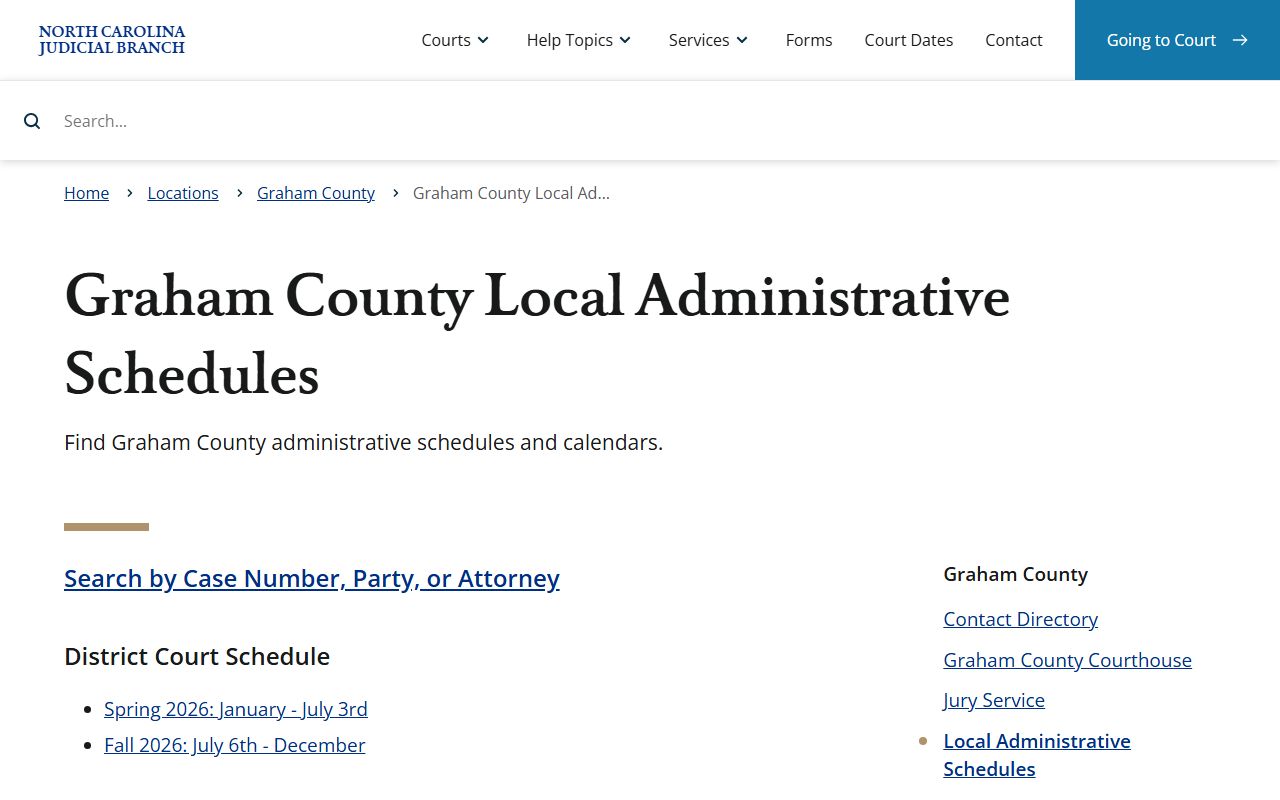
Schedule pages are useful for docket context, while Portal and the clerk are better for a named case lookup.
The local rules and forms page lists Graham County rule links for Superior Court, District Court, criminal docketing, arbitration, and mediation.
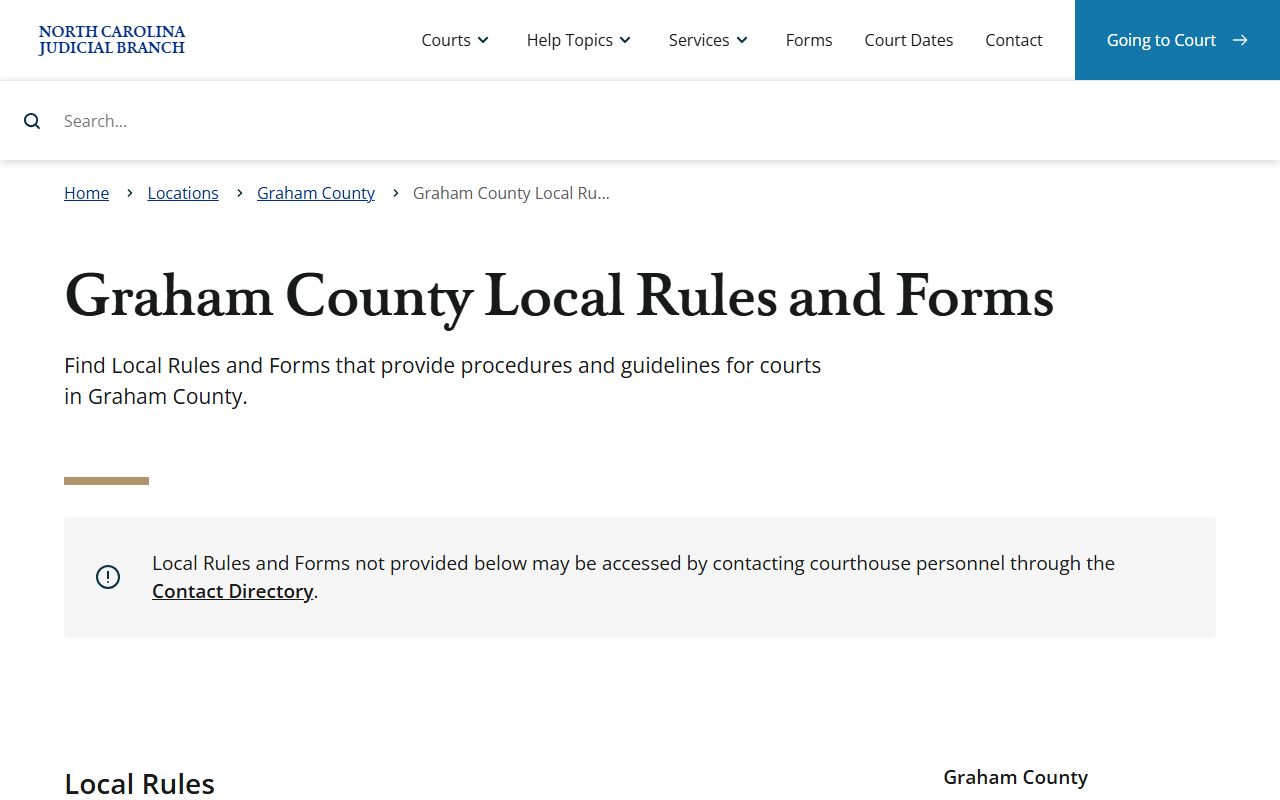
Those local rules help explain why two records with the same broad case type may follow different scheduling paths.
Graham County Courthouse Visits
Graham County jurors are typically summoned for a one-week session, and the local jury page lists a typical juror day as 9:30 AM to 5:00 PM. Jurors must use the reporting instructions on the summons. The local jury information also says no cell phones or electronic devices are allowed, a point that visitors should take seriously before entering the courthouse.
Deferral or excusal requests must be submitted by electronic form, in person, or by mail at least seven days before service. Mail requests go to the Graham County Clerk of Superior Court, ATTN: Jury Clerk, PO Box 1179, Robbinsville, NC 28771. Requests cannot be handled by telephone. Graham County Transit can help some residents reach Robbinsville court offices, but official fixed courthouse stop details were not located.
The Graham County jury service page documents the one-week service term, electronics rule, and deferral routing.
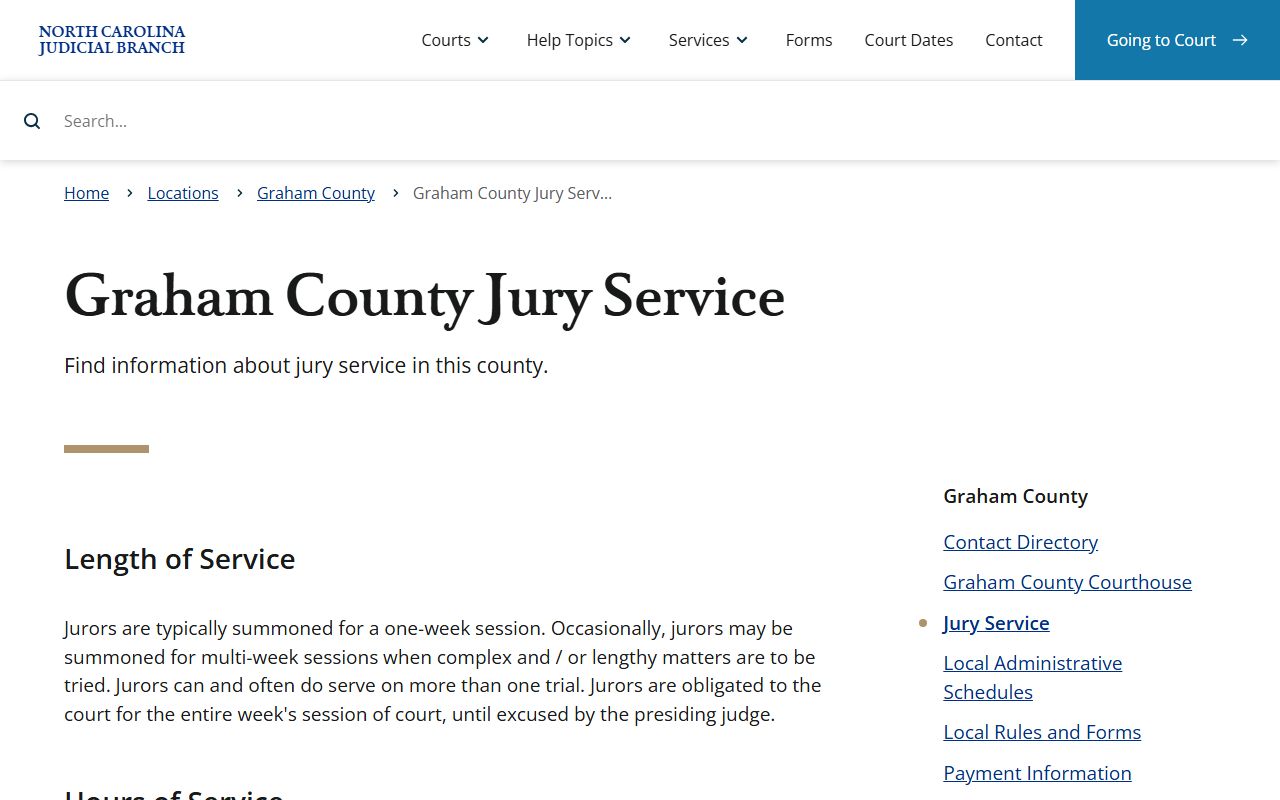
Jury service rules are a useful courthouse access check even for people visiting for records rather than a trial.
Graham County Court History
The Graham County Courthouse has a notable local history. The courthouse site was surveyed in 1872, and the first courthouse was erected in 1873. That first building served about twenty years before the courtroom floor collapsed under the weight of a crowd gathered for a murder trial. A second courthouse was dedicated in July 1895 on the same site.
The current courthouse was built in 1941-1942 with Works Projects Administration assistance. The National Register nomination describes a native-stone Neoclassical Revival building designed by Barber and McMurry of Knoxville. The stone was reportedly quarried from the Mill Creek area. The building remains central to county government and court records access in Robbinsville.
Graham County eCourts Changes
Western North Carolina counties moved into the eCourts environment on July 22, 2024, expanding online public access to court records, dockets, payments, and hearing searches. That change is why Graham County appears in Portal location filters. Recent court-cost updates are also important, since the Judicial Branch current court costs page was updated for 2026 cost charts.
Census QuickFacts for Graham County gives official county context for population and local scale.
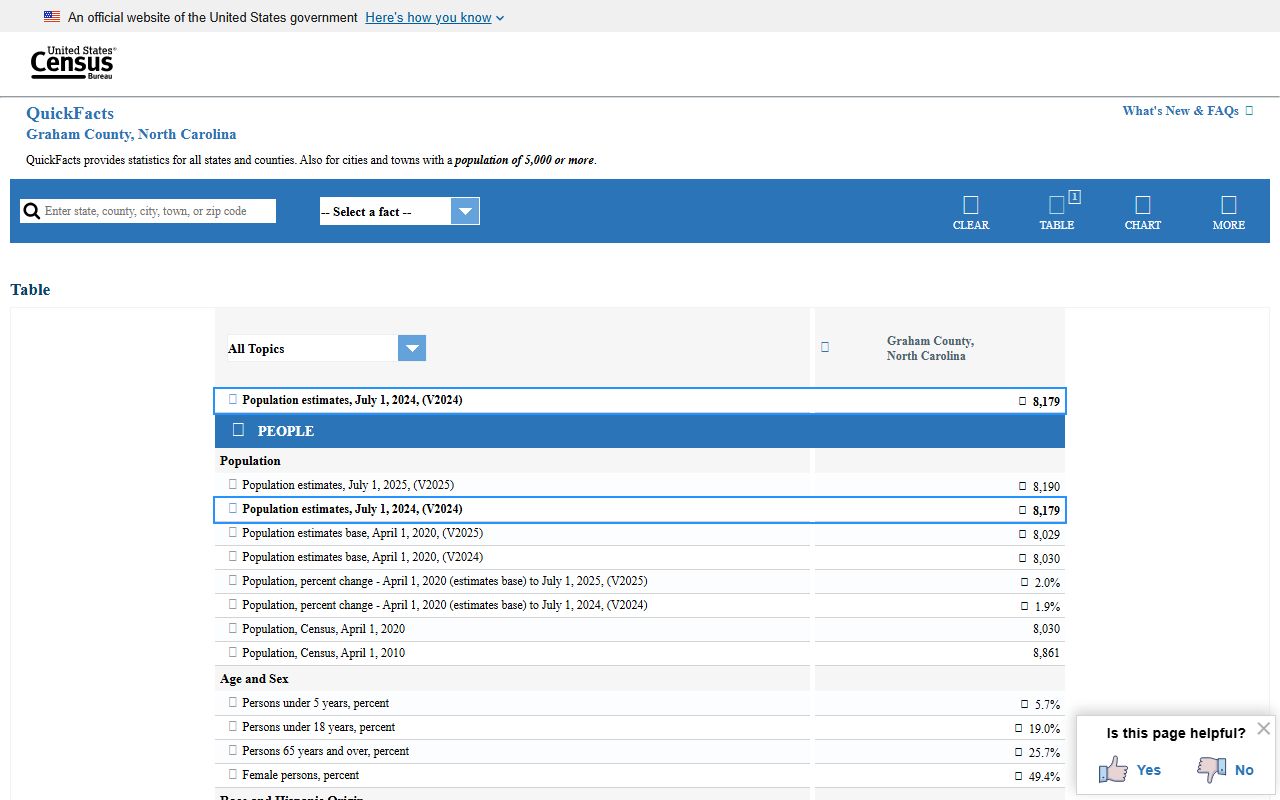
Population and rural access context help explain why phone, mail, transit, and counter access remain important beside online search.
Graham County Court Records FAQ
Can Graham County court records be searched online? Yes, many case and hearing details can be searched through the NC eCourts Portal. Full files, certified copies, older records, and some paper records still require the Clerk of Superior Court.
Does Graham County publish a jail roster? No official online Graham County jail roster was verified in the research. Call the jail at (828) 479-8650 for local custody routing.
Where are divorce judgments kept? Divorce judgments are court records kept by the Clerk of Superior Court in the county where the divorce was granted.
Are sheriff investigation files public? North Carolina law treats criminal investigation and intelligence records differently from ordinary public records. Ask the Sheriff's Office what can be released.