
Graham County Arrest Records and Court Charges
An arrest record is the record of the arrest event. It may involve the arresting agency, booking process, custody status, fingerprints, booking photograph, property inventory, charge entry, and safety screening. In Graham County, the official sheriff page identifies Sheriff Russell Moody and the jail contact, but it does not publish an official online county jail roster or booking search. Custody questions should be routed to the jail when a person may be held locally.
A court charge record is different. It shows what offense is filed in court after arrest or citation, the charge level, the case number, bond or release entries when shown, court dates, amendments, dismissals, reductions, and eventual disposition. The full case file and sentence belong in Graham County criminal court records. The arrest-to-charges pathway uses both law enforcement and court channels, so one office rarely answers every question.
Search Graham County Arrest Records and Charges
There is no verified official Graham County online jail roster in the research. For the arrest or booking side, call the Graham County jail at (828) 479-8650 or the sheriff's office at (828) 479-3352. For charges filed into court, use the North Carolina eCourts Portal Smart Search, Search Hearings, and the Graham County Clerk of Superior Court. Public terminal searches at clerk offices can search criminal records by defendant name, case number, or victim and witness name.
- For custody or booking status, call the Graham County jail and confirm whether the person is still held locally.
- For filed charges, search Portal Smart Search by case number or defendant name.
- Select Graham County in the Portal location filter to limit the court charge search.
- Open the case information and read each charge line with its status, court date, and disposition.
- Use Search Hearings to confirm the next court date for the charge.
- Contact the Clerk of Superior Court for file review, copies, or certified charge and disposition records.
The Graham County sheriff page is one successful source assigned to this Graham County charge page.
Its value is contact routing, not an online booking or mugshot database.
Graham County Charges After Arrest
After an arrest, a magistrate may issue a warrant or set bail, and the prosecutor decides how to proceed with the criminal charge. In North Carolina practice, the court file may involve a citation, warrant, complaint, information, indictment, or other proper charging path depending on the offense and stage. Graham County is in Prosecutorial District 43, where the district attorney's office handles prosecution decisions for the district.
| Document | Who Uses It | What It Does | Graham County Context |
|---|---|---|---|
| Complaint / citation / warrant | Officer, complainant, magistrate, or prosecutor depending on process | Starts or supports a criminal accusation in court. | Common in misdemeanor, infraction, warrant, and early District Court matters. |
| Information | Prosecutor | Files formal charges where the law allows prosecution by information. | Shows the prosecutor's chosen charge path when used. |
| Indictment | Grand jury | Charges a felony or other matter through grand jury action. | Felony cases proceed in Superior Court after the proper charging path. |
Graham County Charge Status Terms
Charges can change. A person may be arrested on one accusation, then later face an amended charge, a reduced charge, an added count, or a dismissal. A Graham County court charge record should be read charge by charge, because each count can have a different status and final outcome.
| Status | What It Means | How to Verify |
|---|---|---|
| Pending | The charge is filed and still open. | Check Portal, Search Hearings, and the clerk for the next court date. |
| Amended | The charge language or count changed after filing. | Read later docket entries and orders, not just the first charge line. |
| Reduced | The charge was lowered as part of prosecution, plea, or court action. | Confirm the original charge, final charge, and disposition. |
| Dismissed | The charge was terminated by court or prosecution action. | Get a copy from the clerk if proof is needed. |
| Disposed | The charge has an outcome, such as guilty, not guilty, dismissed, or other result. | Match the disposition to the sentence or costs if any were imposed. |
Graham County Charge Decisions
The District Attorney decides how filed charges are prosecuted, whether charges are reduced or dismissed, and how plea negotiations proceed. Graham County is in Prosecutorial District 43 with Cherokee, Clay, Haywood, Jackson, Macon, and Swain counties. The North Carolina Conference of District Attorneys lists District Attorney Ashley Hornsby Welch for the district, while the Graham County Judicial Branch contact directory provides courthouse routing for the District Attorney.
The Public Defender is not a records office, but public defense matters when a charge becomes a pending criminal case. NCIDS lists Defender District 43 and Chief Public Defender Janna D. Allison, with a Waynesville office for appointed representation. Eligible defendants may receive appointed counsel, but records, copies, and docket entries still route through Portal and the Clerk of Superior Court.
The district attorney lookup is a source for Graham County charge routing and Prosecutorial District 43 identity.
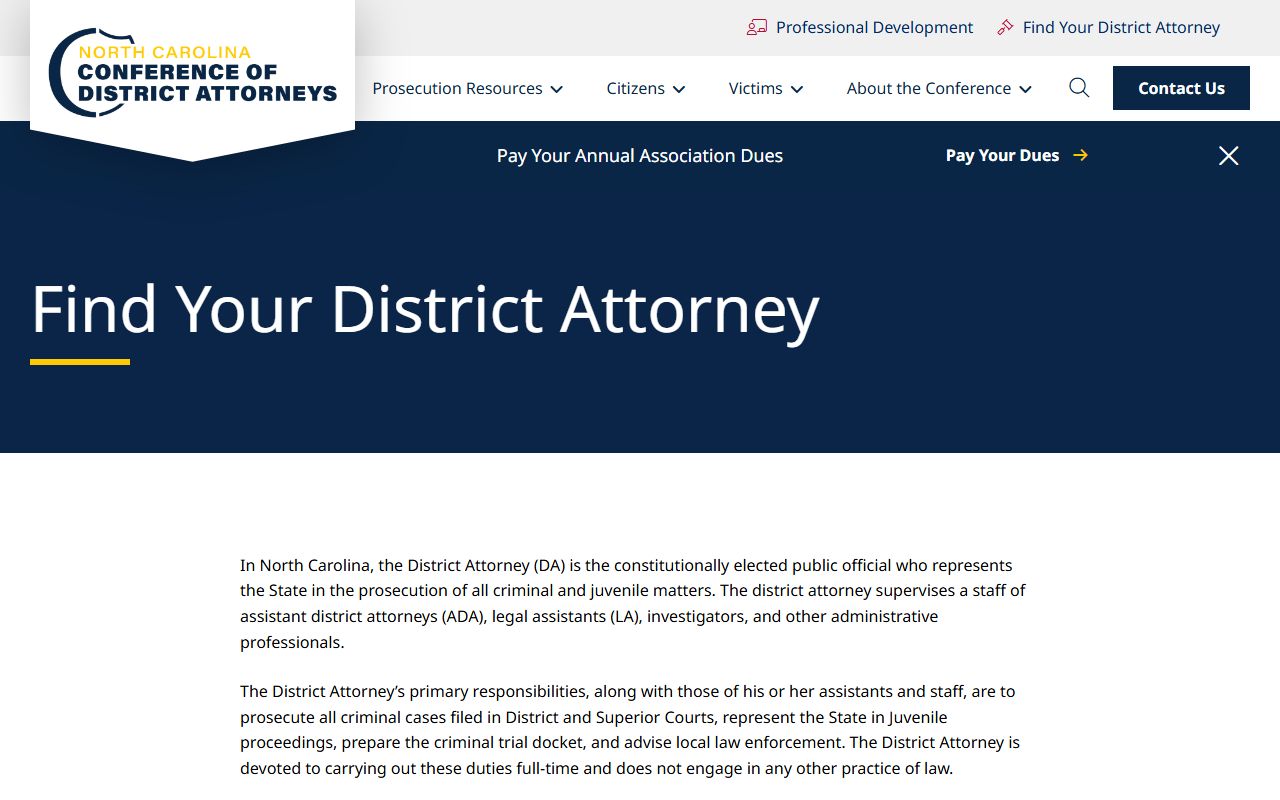
Use it to identify the prosecutorial district, then use the clerk for filed charge records.
A public biography for Ashley Hornsby Welch is also assigned to this page as a district attorney source.
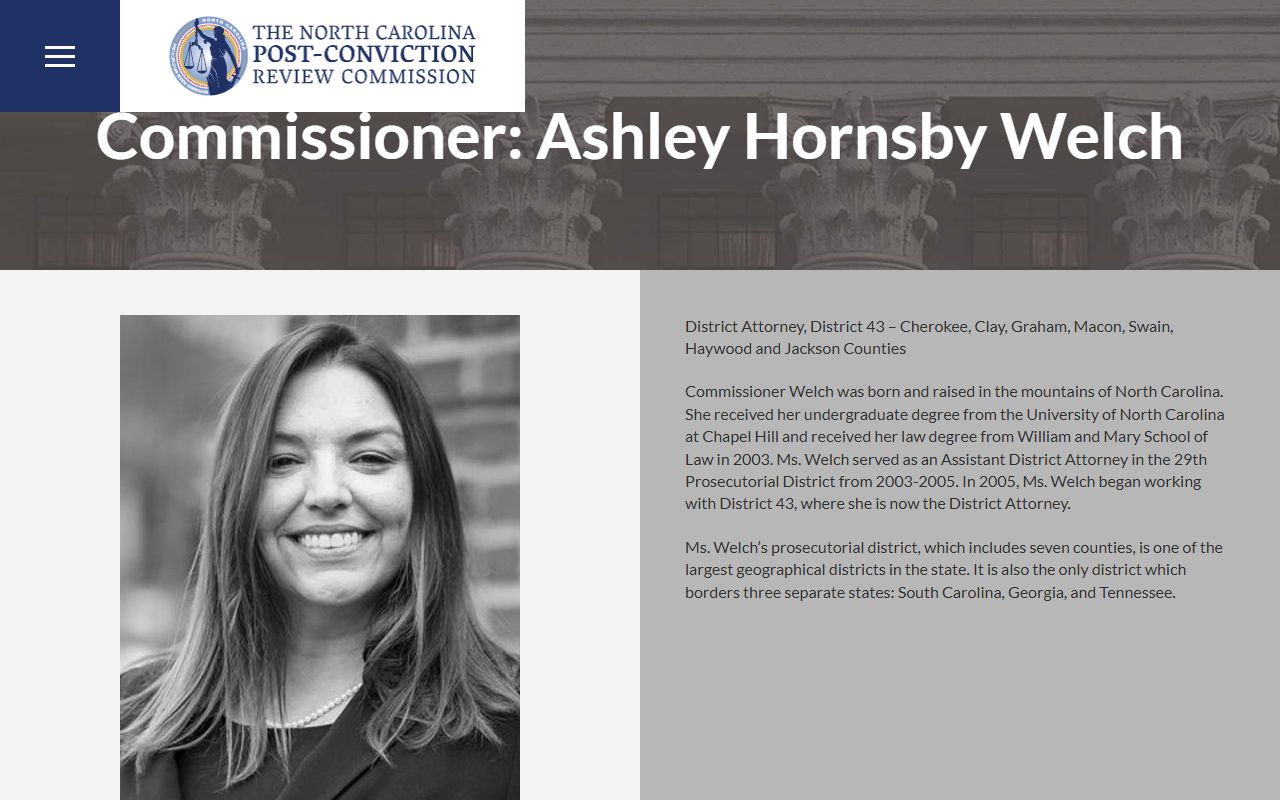
The biography supports district identity, but it does not replace court records for charge status.
The NCIDS defender directory provides the public defense side of the same charge process.
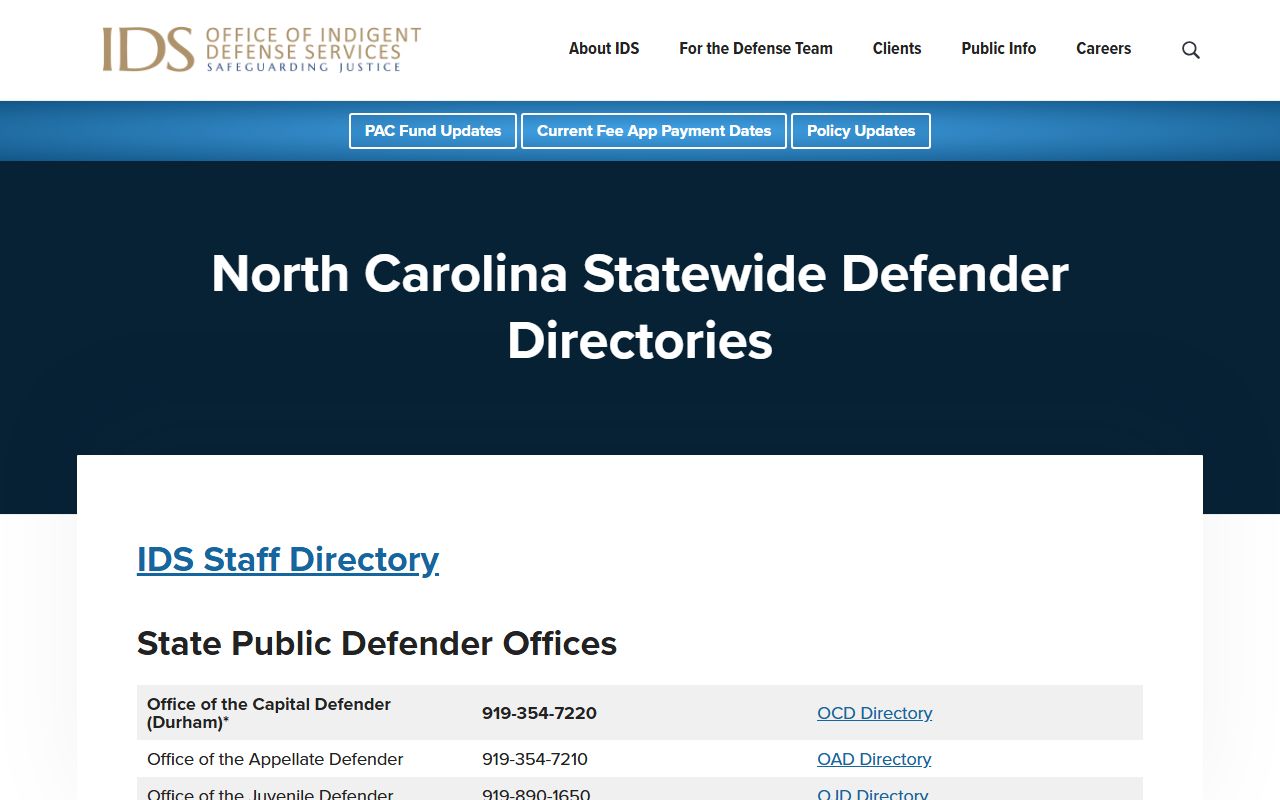
Defense directory information helps with appointed-counsel routing, not with public charge lookup.
Charges vs Convictions
Being charged is not the same as being convicted. An arrest can lead to a filed charge, but that charge may later be dismissed, reduced, amended, or resolved with no conviction. A conviction requires a guilty plea, guilty verdict, or other finding that results in criminal guilt. Read the charge line with the disposition and sentence, not alone.
| Point | Charge | Conviction |
|---|---|---|
| Meaning | An accusation filed after arrest, citation, warrant, complaint, information, or indictment. | A final guilt finding through plea, verdict, or other court result. |
| Timing | Early in the case and subject to change. | After adjudication or plea. |
| Record risk | Can be misread if later dismissed or reduced. | Must be read with sentence, probation, appeal, and expunction status. |
| Proof source | Portal, hearing search, and clerk file. | Clerk judgment, disposition, and certified copy when needed. |
Graham County Charge Codes
North Carolina court records can show whether a matter is criminal or infraction through the case number. Traffic cases often use the last two digits of the year, then CR for criminal offenses or IF for infraction-only cases. A ticket can contain both a criminal offense and an infraction, and if a criminal offense is included, the case may use CR. Felony charges move through Superior Court, while misdemeanors and infractions are District Court matters unless appealed or otherwise moved by law.
One arrest can produce several charges. Each charge may have its own statute, description, severity level, bond condition, court date, status, disposition, and sentence. For that reason, a summary result should not be treated as a complete charge history. For legal proof, request the clerk's record or a certified disposition.
Graham County Arrest Records Boundaries
Public access changes by record type. Filed adult court charges are generally accessed through Portal, Search Hearings, clerk terminals, and the Clerk of Superior Court. Sheriff and jail records are separate, and the county public-records policy says requests to independent offices such as the Sheriff's Office should be made directly to those officials. The county-manager public records process asks for written requests by hand delivery, mail, or email and says phone requests are not accepted for that process.
Use the Graham County court contact directory for clerk, district attorney, and magistrate routing, and the Graham County public records page for county-record request contacts outside the court file. Court charges go through Portal and the clerk; sheriff records go to the sheriff; jail custody questions go to jail staff.
Law enforcement criminal investigation records are not public records under N.C.G.S. 132-1.4. That limit matters for arrest records because a basic booking or court charge may be available while investigative reports, witness statements, and criminal intelligence are not. Juvenile charges, sealed records, expunged entries, adoption material, mental health proceedings, and personal identifiers are also restricted.
Note: No official Graham County sheriff app or online jail roster was verified in the official-source research.
Sealed vs Expunged Charges
A sealed charge is hidden from ordinary public access by law or order. An expunged charge is cleared from public record entries after a judge grants relief and agencies process the order. North Carolina expunction eligibility depends on the offense, result, age, waiting period, prior record, and the statute used. Some dismissed charges, not-guilty findings, juvenile matters, and certain nonviolent convictions may have different paths.
| Point | Sealed | Expunged |
|---|---|---|
| Public search | Hidden from normal Portal or terminal access. | Cleared from public record after the order is processed. |
| Typical source | Statute or court order. | Petition, statutory eligibility, judge's order, agency processing. |
| Charge effect | The charge may still exist with limited access. | The public entry is treated as cleared under expunction law. |
| Verification | Ask the clerk about access authority. | Use Judicial Branch forms, the clerk, and current court costs. |
Statewide Charge Record Checks
Statewide databases answer different questions. The NC Department of Adult Correction offender search covers state prison offenders, probationers, parolees, and historical data. It is not a Graham County jail roster and does not list every arrest or filed charge. The NCSBI sex offender registry is a separate registry for sex offender registration, not a general criminal case search.
For current local charges, use Portal and the clerk. For custody in Graham County, call the jail. For a state-sentenced offender, use NC DAC. For a pending warrant or order for arrest, contact the magistrate, sheriff, clerk, or counsel, because Portal is not a live warrant database.
Important: Arrest and charge lookups are not FCRA consumer reports and should not be used for regulated screening decisions.